

Cybersecurity risk assessment dashboard in a modern business environment
Cybersecurity Risk Assessment Guide

Digital threats target every business, regardless of size or industry. Most organizations know they face risks but struggle to identify which vulnerabilities pose the greatest danger or deserve priority attention.
Think of a cybersecurity risk assessment as a diagnostic health screening for your IT environment. It reveals hidden weaknesses, quantifies potential damage, and helps you invest security dollars where they'll deliver maximum protection. Companies that skip this step essentially drive blindfolded—they might avoid accidents through luck, but they'll eventually crash when threats materialize.
The damage from operating without clear risk visibility includes stolen customer data, ransomware shutdowns, compliance fines, and erosion of customer trust that can take years to rebuild.
What Is a Cybersecurity Risk Assessment
Picture this: You're trying to protect your house, but you don't know whether the front door locks properly, if windows get left open at night, or whether valuables sit visible from the street. That's how organizations operate without conducting formal security risk evaluations.
A cybersecurity risk assessment explained simply means you're taking inventory of everything valuable in your digital environment, figuring out what could go wrong, and deciding how to prevent the worst outcomes. This structured examination goes beyond installing antivirus software or updating passwords—it creates a complete picture of your security posture.
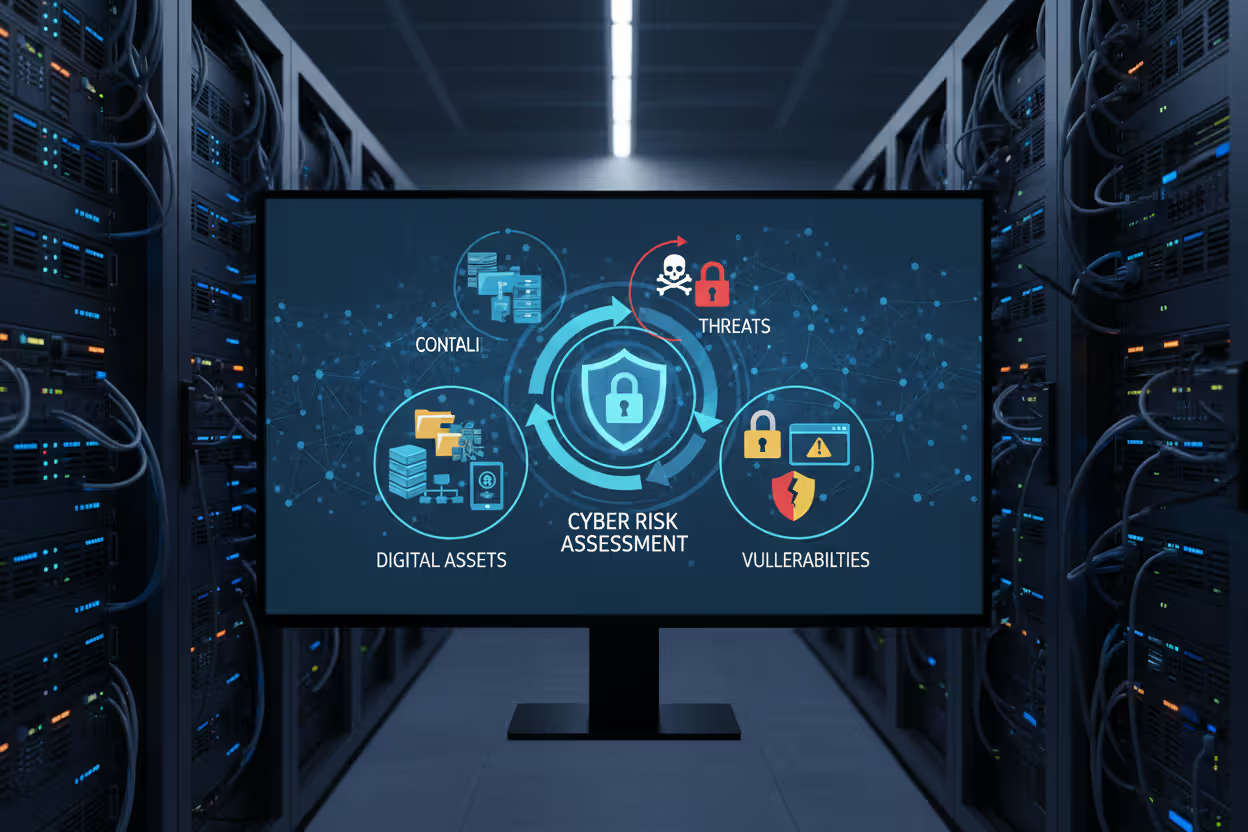
Three components form the core of any assessment: the assets you're protecting (customer databases, financial systems, proprietary designs), the threats that want to compromise them (ransomware gangs, disgruntled employees, state-sponsored hackers), and the vulnerabilities that could let attacks succeed (unpatched servers, weak passwords, missing backups).
Author: Alyssa Norwood;
Source: elegantimagerytv.com
Let's use a manufacturing company as an example. Their most valuable assets include the industrial control systems running production lines, trade secrets for product formulas, and customer order databases. Threats range from ransomware operators who'd shut down production for ransom payments, to competitors who'd love to steal manufacturing processes, to nation-state actors targeting supply chains. Vulnerabilities might include factory floor systems running Windows XP that can't be updated, employees who click suspicious email attachments, or remote access connections without multi-factor authentication.
This cybersecurity risk assessment overview reveals gaps in technical defenses, flawed procedures, missing policies, and inadequate staff training. You're not just checking boxes—you're building a complete map of where your defenses need strengthening.
Statistics tell a compelling story: companies performing regular security assessments face 30-40% fewer successful breaches than businesses taking an informal approach. The structured methodology catches problems before attackers exploit them and creates documentation that satisfies auditors and regulators.
How Cybersecurity Risk Assessment Works
Understanding how cybersecurity risk assessment works means following a logical sequence that transforms scattered security concerns into a prioritized action plan.
Asset Identification starts the process. You'll catalog every system, application, database, network device, and data repository across your environment. Don't limit yourself to traditional IT—include mobile phones, cloud services, IoT devices, partner connections, and vendor platforms that touch your network. Each asset gets tagged with details about its business purpose, data sensitivity, and operational importance.
Consider a hospital's approach. Their electronic health record platform clearly qualifies as mission-critical since doctors and nurses depend on it for patient care. The cafeteria's point-of-sale system matters far less to core operations. This ranking prevents wasting resources protecting low-value targets while critical systems remain exposed.
Threat Analysis examines who might attack you and why. External adversaries include organized crime syndicates running ransomware operations, foreign intelligence services stealing intellectual property, hacktivists targeting companies whose practices they oppose, and opportunistic attackers scanning the internet for easy victims. Internal threats come from employees with malicious intent, careless staff who fall for scams, or former workers whose credentials weren't deactivated. Don't forget non-malicious threats like equipment failures, natural disasters, or supplier bankruptcies.
Skip the generic threat lists you'll find in textbooks. A credit union faces different adversaries than a defense contractor. The credit union worries about account takeover fraud, business email compromise targeting wire transfers, and ATM skimming networks. The defense contractor focuses on state-sponsored espionage, insider threats selling classified information, and sophisticated persistent intrusions.
Vulnerability Assessment exposes weaknesses attackers could exploit. Technical vulnerabilities include software missing security patches, firewalls with overly permissive rules, encryption implemented incorrectly, or APIs lacking proper authentication. Organizational vulnerabilities encompass employees untrained in security awareness, incident response plans that exist only on paper, or privileged access granted too broadly.
Automated scanners detect known software flaws, but they'll miss the procedural issues that cause real damage. A scanner identifies missing patches perfectly, but only experienced security professionals recognize that your change management process creates three-month delays before any patches get installed.
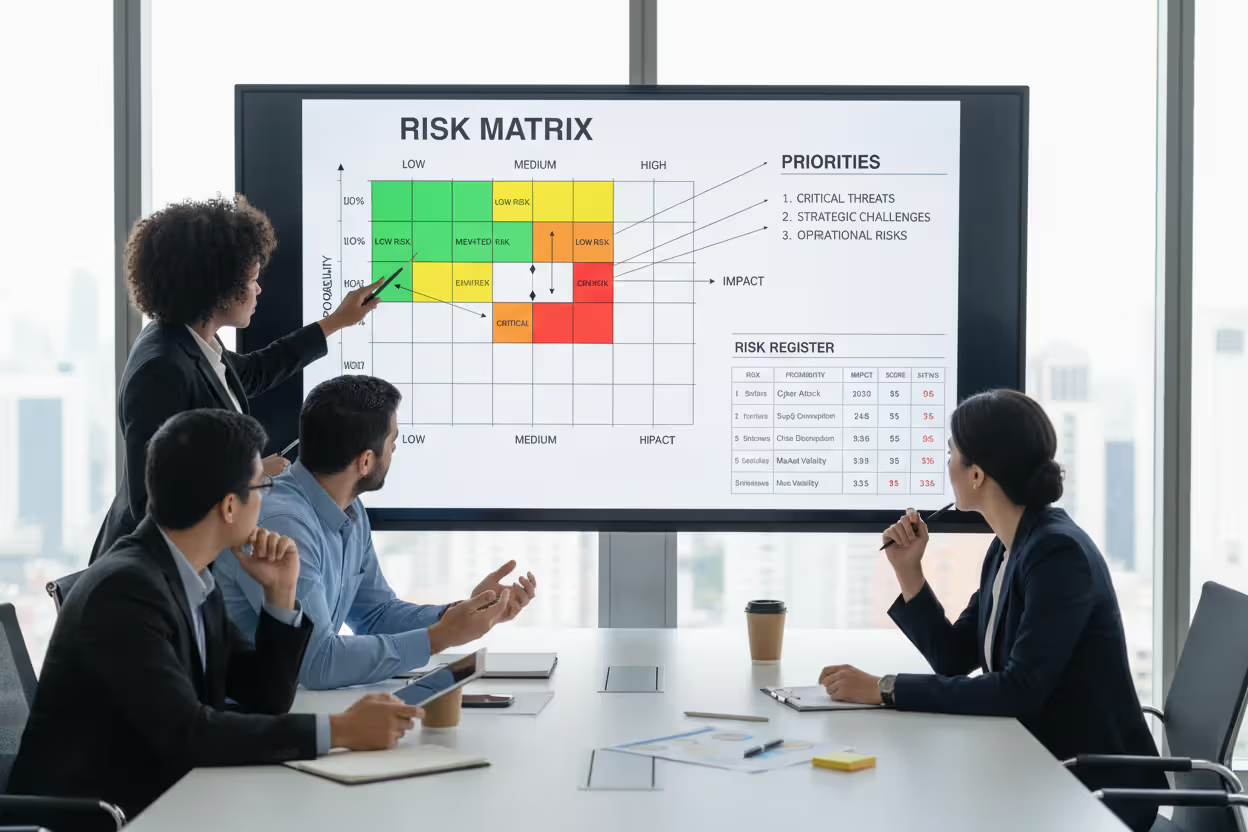
Risk Evaluation combines likelihood of successful attacks with magnitude of potential damage. An easily exploited vulnerability in a non-critical system poses less danger than a difficult-to-exploit weakness in infrastructure supporting revenue-generating operations. This calculation directs remediation efforts toward the risks that actually threaten your business.
Author: Alyssa Norwood;
Source: elegantimagerytv.com
Mitigation Planning converts assessment findings into specific security improvements. High-severity risks get addressed immediately through technical controls, architectural redesigns, or process changes. Medium-priority risks enter your project roadmap with defined completion dates. Low-priority risks might be formally accepted with documented rationale, or addressed through compensating controls when direct fixes aren't feasible.
Types of Cybersecurity Risk Assessments
Different assessment methodologies suit different organizational needs. Your choice depends on available resources, security program maturity, and the precision required for decision-making.
Qualitative assessments describe risks using categories instead of precise numbers. You'll rate likelihood and impact as "low," "medium," or "high" based on professional judgment, industry experience, and collective team expertise.
Small businesses with limited security staff prefer this approach. You don't need statistical modeling skills or extensive historical data. The downside? Two security professionals might rate identical risks differently based on their individual perspectives and risk tolerance.
Quantitative assessments calculate specific dollar amounts for potential losses. Frameworks like Factor Analysis of Information Risk (FAIR) estimate how much money you'd lose annually by multiplying attack frequency by expected damage per incident.
Here's a concrete example: quantitative analysis determines your company faces ransomware attacks with 15% annual probability, each incident costing approximately $2.3 million on average. That calculation yields an expected annual loss of $345,000. This precision helps justify security spending by demonstrating clear return on investment to executives and boards.
The catch? You need substantial data. Historical incident records, detailed asset valuations, threat intelligence showing attack frequencies, and statistical analysis capabilities. Most organizations lack this information when starting their security programs.
| Factor | Qualitative Approach | Quantitative Approach |
| Risk Rating Method | Categories like low/medium/high | Dollar values and percentages |
| Information Needed | Basic threat awareness and asset knowledge | Historical incidents, attack statistics, financial models |
| Result Precision | Varies based on evaluator experience | Repeatable calculations with documented assumptions |
| Ideal Situations | Starting security programs, resource constraints | Established programs, justifying major investments |
| Technical Demands | Moderate—requires security knowledge | Significant—needs data analysis expertise |
Internal assessments leverage your own employees to evaluate security risks. Your team already understands the business context, knows where the skeletons hide, and costs less than external consultants. However, insider teams often develop blind spots, lack objectivity about problems they may have contributed to, and miss emerging attack techniques outside their direct experience.
External assessments bring independent security firms to examine your environment. Third-party consultants offer fresh perspectives unclouded by organizational politics, specialized expertise in emerging threats, and benchmarking data from hundreds of other clients. You'll pay higher fees and potentially deal with consultants who need time to understand your unique business environment.
Compliance-driven assessments target specific regulatory requirements. Healthcare organizations conduct HIPAA security rule assessments. Payment card processors follow PCI DSS assessment procedures. Government contractors complete NIST 800-171 compliance evaluations. These follow prescriptive frameworks and generate documentation for auditors. The limitation? Compliance checklists sometimes miss organization-specific risks that fall outside regulatory scope.
Strategic assessments take a broader business perspective. How does security posture affect your competitive position? What risks threaten long-term viability? Could security weaknesses prevent you from pursuing new market opportunities? A strategic assessment might reveal that inadequate security practices disqualify your company from bidding on lucrative government contracts or landing enterprise customers who require vendor security certifications.

Author: Alyssa Norwood;
Source: elegantimagerytv.com
Step-by-Step Process for Conducting a Risk Assessment
This cybersecurity risk assessment guide walks through a practical implementation approach that delivers actionable results.
Identify and Prioritize Assets
Start building a comprehensive inventory of information assets across your organization. Hardware includes servers, employee computers, network switches and routers, mobile devices, and IoT sensors. Software encompasses business applications, operating systems, databases, and development tools. Data covers customer information, financial records, trade secrets, and employee personal information. Services include cloud platforms, SaaS applications, and managed security providers.
Record where each asset lives, who owns it from a business perspective, which employees access it, and what information it processes. A spreadsheet works fine initially, though dedicated asset management platforms help as your inventory grows. Avoid analysis paralysis—start with major systems and fill in details progressively.
Rate each asset's business value considering operational criticality, revenue contribution, regulatory significance, and competitive importance. An e-commerce platform generating 70% of company revenue obviously ranks as critical. The internal employee directory used occasionally for contact information receives lower priority.
Map dependencies between assets. You might initially dismiss a DNS server as low-priority until realizing that its failure would take down every customer-facing service. These relationship maps reveal cascading failure scenarios.
Identify Threats and Vulnerabilities
Build a threat catalog using industry intelligence reports, security vendor threat feeds, and incident databases. Resist copying generic threat lists—customize them for your specific industry, geographic location, and company profile.
A regional bank faces different adversaries than a global manufacturer. Bank threats include account takeover schemes, insider fraud, ATM jackpotting attacks, and business email compromise targeting large wire transfers. Manufacturing threats center on industrial espionage stealing product designs, ransomware disrupting production operations, and supply chain compromises.
Don't obsess over sophisticated threats while ignoring common ones. Advanced persistent threats make exciting conference presentations, but most actual breaches result from mundane issues: phishing emails, password reuse, and unpatched vulnerabilities known for months. A 20-person accounting firm faces virtually zero risk from nation-state hackers but significant risk from opportunistic ransomware targeting their industry.
Run vulnerability scans using automated tools to identify technical weaknesses. Schedule both authenticated scans (where the tool logs into systems with credentials) and unauthenticated scans (simulating external attackers). Authenticated scans reveal missing patches and configuration problems, while unauthenticated scans show what attackers see from outside your network.
Automated tools only tell part of the story. Manually review access control configurations, examine security policy documentation, interview employees about actual practices, and physically inspect server rooms and network closets. No scanner detects that employees share login credentials written on sticky notes or that someone propped the data center door open for air circulation.
Assess Impact and Likelihood
Evaluate each identified risk by estimating two factors: how likely it is to occur and how much damage it would cause. Likelihood considers whether threat actors possess necessary skills and motivation, how difficult the vulnerability is to exploit, and what security controls currently reduce exposure. Impact examines financial losses, operational disruptions, regulatory penalties, reputational damage, and competitive disadvantage.
Adopt a consistent rating scale—perhaps 1 through 5, where 1 means very low and 5 means very high. Multiply likelihood by impact to calculate a risk score, then rank all risks by their scores to determine priorities.
Here's a practical example: phishing vulnerabilities might receive a likelihood score of 4 (employees receive dozens of phishing attempts monthly, and click-throughs happen regularly) combined with an impact score of 4 (successful phishing could compromise financial systems or customer data). The resulting risk score of 16 places phishing near the top of your priority list.
Compare that to an obscure vulnerability in legacy software that scores likelihood 2 (requires specialized knowledge that few attackers possess) and impact 3 (affects a standalone application with limited data access). The risk score of 6 means you'll address it eventually, but after more pressing concerns.
Document the reasoning behind each rating. Why did you assess that particular likelihood? Which factors influenced the impact estimate? This documentation helps future assessments maintain consistency and explains your risk decisions when executives or auditors question them.
Develop Risk Mitigation Strategies
Define specific actions for addressing each significant risk. You've got several strategic options:
Remediation eliminates the underlying vulnerability completely. Apply software patches, replace end-of-life systems, implement missing security controls, or redesign flawed processes. This approach provides the most thorough protection but isn't always feasible immediately.
Risk transfer shifts financial responsibility through cyber insurance policies, outsourcing to managed service providers with contractual liability clauses, or vendor agreements that impose security requirements. Insurance covers certain financial losses after incidents occur but doesn't prevent breaches from happening.
Risk acceptance means consciously deciding not to mitigate a particular risk, typically because remediation costs exceed potential losses or the risk falls below your organization's acceptable threshold. Document acceptance decisions with clear business justification signed by appropriate executives.
Compensating controls reduce exposure when direct remediation isn't practical. If a critical legacy system can't be patched or replaced, you might implement network segmentation to isolate it, deploy enhanced monitoring to detect exploitation attempts, and restrict access to essential personnel only.
Build a remediation roadmap showing specific tasks, assigned responsibilities, completion deadlines, and required resources. High-priority risks get immediate attention and funding. Medium-priority items enter scheduled project cycles. Lower-priority risks might be batched together for efficient handling.
A manufacturing company discovers that production control systems run software with severe vulnerabilities. Direct patching risks disrupting manufacturing operations worth millions daily. Their remediation plan includes isolating control networks from corporate IT, deploying specialized monitoring for industrial protocols, restricting physical and remote access, and scheduling a comprehensive upgrade during the annual two-week maintenance shutdown.
Track progress through regular reviews—monthly for high-priority items, quarterly for others. Verify that implemented controls actually reduce exposure as intended through testing and validation, not just assuming completion means success.
Real-World Cybersecurity Risk Assessment Examples
Practical cybersecurity risk assessment examples demonstrate how different organizations apply these principles to their unique situations.
Healthcare Organization Example: A 300-bed community hospital conducted their annual security assessment and identified electronic health records (EHR) as the crown jewel requiring protection. Threat analysis highlighted ransomware as the primary concern—healthcare organizations suffered 45% of all ransomware attacks during the previous year according to their research.

Author: Alyssa Norwood;
Source: elegantimagerytv.com
Vulnerability assessment uncovered several concerning weaknesses. Nursing staff accessed EHR from shared workstations in each patient room without logging out between patients, creating credential theft opportunities. Backup systems existed on paper but hadn't been tested for actual restoration in 18 months—no one knew if backups would work during a real emergency. Medical devices like infusion pumps and imaging equipment connected to general IT networks without segmentation, creating pathways for malware to spread from administrative systems to clinical devices.
Impact analysis calculated that complete EHR unavailability would force the hospital to divert ambulances to other facilities, cancel elective procedures, and revert to paper records at an estimated cost of $150,000 per hour. The likelihood received a "high" rating based on industry attack frequency and the specific vulnerabilities discovered.
Mitigation strategies included deploying automatic workstation logout after two minutes of inactivity, conducting quarterly backup restoration drills with documented results, implementing network segmentation separating medical devices from administrative systems, and rolling out endpoint detection and response software on all workstations. The hospital prioritized these initiatives in their capital budget and completed implementation over six months.
Financial Institution Example: A regional credit union serving 50,000 members performed a quantitative risk assessment focusing on online banking fraud. Asset identification prioritized the online banking platform (their primary customer service channel), account database (containing credentials and balances), and wire transfer systems (enabling large-value transactions).
Threat modeling identified credential stuffing attacks as a major risk. Attackers obtain username/password combinations from breaches at other companies, then test those credentials against banking sites, knowing many people reuse passwords. Vulnerability assessment revealed the credit union lacked multi-factor authentication for online banking—just username and password protected accounts. Their fraud detection relied on rule-based systems from 2015 that missed modern attack patterns.
Quantitative analysis estimated 25% annual probability of a significant credential stuffing incident based on attack frequency data from the Financial Services Information Sharing and Analysis Center. Expected losses included $400,000 in fraudulent wire transfers before detection, $150,000 in incident response and forensics costs, $100,000 in regulatory fines and legal expenses, plus reputational damage. Annual loss expectancy totaled $162,500.
The credit union implemented multi-factor authentication for all online banking users, upgraded to machine learning-based fraud detection, and deployed real-time account monitoring. These controls cost $75,000 initially plus $20,000 annually in licensing but reduced estimated annual loss expectancy to $35,000, demonstrating clear return on investment that justified the expense.
Small Business Example: A 25-person marketing agency conducted their first formal risk assessment after hearing that a competitor paid $50,000 in ransomware demands. Asset inventory revealed that client creative files (representing months of billable work), strategic marketing plans (containing client confidential information), and financial records represented their most valuable data.
The assessment identified alarming vulnerabilities. No formal backup procedures existed—individuals saved files to various locations including local hard drives, personal cloud accounts, and shared network drives without consistency. Employees used personal laptops and tablets for work without security requirements or management oversight. Administrative credentials for critical accounts were shared among multiple staff members via a spreadsheet. The agency relied entirely on Microsoft 365 and Adobe Creative Cloud without understanding the shared responsibility model that makes customers responsible for data protection even in cloud services.
Impact analysis showed that losing client files would trigger contract breaches, damage the agency's reputation among a tight-knit industry, and potentially cause business failure. The small team lacked budget for enterprise security tools, so mitigation focused on high-impact, low-cost controls: implementing automated backups to business-class cloud storage with tested restoration procedures, requiring password managers and unique credentials for each account, establishing a bring-your-own-device policy with minimum security standards (antivirus, full-disk encryption, screen locks), and conducting quarterly security awareness training covering phishing, password security, and data handling.
Common Mistakes to Avoid During Risk Assessments
Even organizations with good intentions stumble during risk assessments. Recognizing these patterns helps you avoid wasted effort and incomplete results.
Incomplete asset inventories sabotage everything that follows. Organizations consistently overlook shadow IT (applications employees adopt without IT approval), cloud services signed up with corporate credit cards, contractor and vendor access, and IoT devices like security cameras or smart HVAC systems. A risk assessment that misses 30% of actual assets leaves dangerous blind spots where breaches incubate undetected.

Author: Alyssa Norwood;
Source: elegantimagerytv.com
Treat asset inventory as a continuous process rather than a one-time project. New systems, services, and data repositories appear constantly through normal business operations. An inventory more than 90 days old probably misses significant assets.
Ignoring human factors while obsessing over technical details creates false confidence. Technical vulnerabilities receive exhaustive attention—every missing patch documented, every misconfigured firewall noted. Meanwhile, organizational weaknesses get cursory treatment despite causing most actual breaches. Social engineering, weak security culture, and inadequate training enable more successful attacks than sophisticated zero-day exploits.
Test security awareness through unannounced phishing simulations, review policy compliance through spot checks, and interview staff about their actual practices versus official procedures. A company might deploy excellent firewalls while suffering breaches because employees click malicious links or photograph passwords on sticky notes to share with coworkers.
Failing to update assessments regularly leaves you operating on outdated intelligence. Threat landscapes shift as new attack techniques emerge. Software vulnerabilities get discovered daily. Business operations change through growth, new products, and market evolution. Security controls degrade over time as configurations drift and maintenance lapses.
Conduct comprehensive assessments annually at minimum—quarterly for high-risk environments like financial services or healthcare. Trigger additional targeted assessments after major changes: mergers and acquisitions, significant system deployments, security incidents affecting your industry, or regulatory changes imposing new requirements.
Treating risk assessment as compliance theater rather than a strategic management tool squanders opportunities. Organizations checking boxes to satisfy auditors produce binders of documentation that gather dust rather than driving security improvements. Staff view assessments as bureaucratic requirements unconnected to real work.
Integrate findings into budget planning, project approval workflows, and strategic business decisions. When risk assessment reveals that legacy systems pose unacceptable dangers, that information should influence technology refresh schedules and capital expenditure priorities. Security risks belong in the same executive conversations as financial risks and operational risks.
Overrelying on automated tools without applying human judgment produces noise instead of insight. Vulnerability scanners identify thousands of known technical flaws but can't distinguish between critical risks in production systems and minor issues in isolated development environments. Automated tools flag issues without understanding business context, architectural constraints, or compensating controls.
Combine automated scanning with manual code review, configuration analysis, penetration testing, and expert assessment. A skilled security professional recognizes that a medium-severity vulnerability in a system processing confidential customer data poses greater business risk than a critical vulnerability in an isolated test environment with no sensitive information.
Inadequate stakeholder engagement limits both accuracy and implementation success. IT security teams conducting assessments in isolation miss crucial business context, misunderstand which systems actually matter to operations, and struggle to implement recommendations without executive sponsorship or departmental cooperation.
Involve business unit leaders, finance, legal, human resources, and operations throughout the entire assessment process. They provide essential context about asset value that IT might not recognize, understand operational dependencies that security teams don't see, and help define acceptable risk levels aligned with business strategy.
Companies conducting regular, thorough risk assessments aren't just satisfying compliance requirements—they're building fundamental understanding of their security posture that enables smart decisions at every organizational level. The difference between organizations that survive major cyber incidents versus those that fail often traces directly back to whether they identified their critical vulnerabilities before attackers discovered them
— Kevin Mandia
Frequently Asked Questions
Cybersecurity risk assessments transform security from reactive firefighting into proactive risk management that protects your business systematically. Organizations that methodically identify assets, analyze relevant threats, evaluate vulnerabilities, and implement targeted controls slash their exposure to costly breaches and operational disruptions.
This process demands commitment beyond satisfying compliance auditors. Effective assessments require cross-functional collaboration that brings together IT, business operations, finance, and legal perspectives. Regular updates keep pace with evolving threats and changing business operations. Integration with business decision-making ensures security considerations inform strategic choices about technology investments, new product launches, and market expansion.
Security threats never stop evolving, making one-time assessments dangerously insufficient. Organizations that embed risk assessment into their operational rhythm—continuously updating asset inventories, monitoring emerging threat patterns, and adapting defensive controls—build resilience that withstands shifting attack landscapes. The investment in structured risk evaluation pays dividends through prevented breaches, optimized security spending, and stakeholder confidence that you're actively protecting critical assets rather than hoping nothing bad happens.
Related Stories

Read more

Read more




The content on this website is provided for general informational and educational purposes only. It is intended to explain concepts related to cybersecurity awareness, online threats, phishing attacks, and data protection practices.
All information on this website, including articles, guides, and examples, is presented for general educational purposes. Cybersecurity risks and protection strategies may vary depending on individual behavior, technology usage, and threat environments.
This website does not provide professional cybersecurity, legal, or technical advice, and the information presented should not be used as a substitute for consultation with qualified cybersecurity professionals.
The website and its authors are not responsible for any errors or omissions, or for any outcomes resulting from decisions made based on the information provided on this website.